
Posted At: Sep 14, 2026 - 67 Views

The wearable technology landscape continues to evolve at a remarkable pace, with Near Field Communication emerging as a transformative feature in next-generation smart glasses. For B2B buyers, distributors, and brands seeking competitive advantages in the OEM/ODM smart glasses market, understanding NFC integration represents a critical strategic consideration.
NFC technology enables short-range wireless communication between devices through electromagnetic induction. When embedded in smart glasses, this capability unlocks a spectrum of practical applications ranging from contactless payments to instant device pairing and secure access control. As consumer expectations shift toward seamless, hands-free interactions, smart glasses equipped with NFC functionality are positioned to capture significant market share across retail, healthcare, logistics, and enterprise sectors.
Understanding NFC Technology in Wearable Devices
NFC operates at a frequency of 13.56 MHz and enables communication between two devices when they are brought within 4 centimeters of each other. This proximity requirement ensures secure data exchange while preventing unintended activations. In the context of smart glasses, NFC chips can be integrated into the temple arms or frame components, maintaining a slim profile while delivering powerful functionality.
The technology supports three distinct modes of operation. Peer-to-peer mode allows bidirectional data transfer between two NFC-enabled devices, making it ideal for sharing contact information or media files. Read-only mode enables smart glasses to scan NFC tags embedded in physical objects, opening doors for retail navigation and inventory management applications. Write mode permits the glasses to program NFC tags with custom data, supporting authentication and tracking use cases.
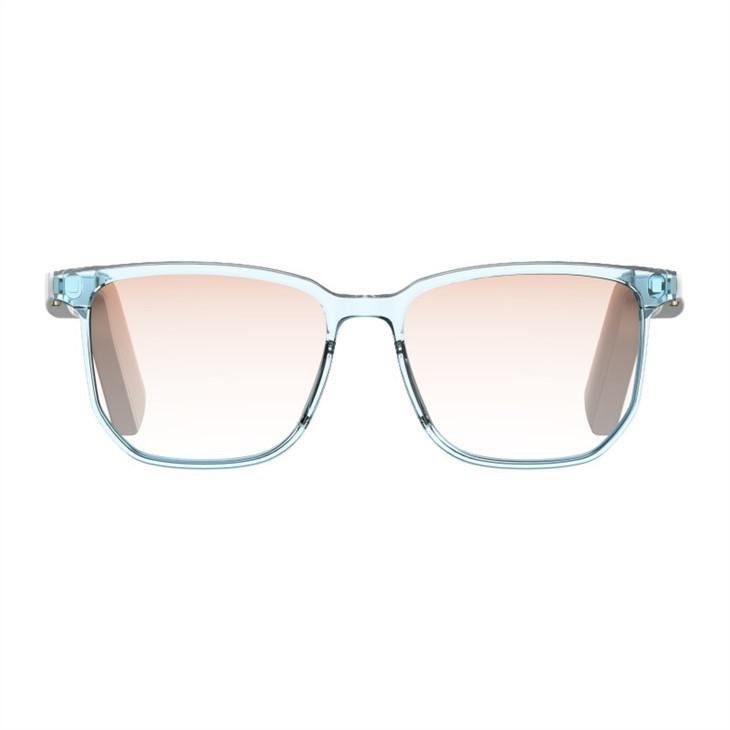
For brands exploring product development, our Bluetooth 5.0 Smart Glasses demonstrate how advanced connectivity features can be seamlessly integrated into consumer-ready designs while maintaining aesthetic appeal and wearing comfort.
Key Applications Driving NFC Smart Glasses Adoption
Contactless Payment Systems
Payment capability stands as one of the most compelling use cases for NFC-enabled smart glasses. By integrating secure payment chips and partnering with payment processors, brands can offer consumers the ability to complete transactions with a simple glance and tap. This functionality proves particularly valuable in retail environments, where staff can process payments without reaching for cards or mobile devices.
The payment ecosystem for wearables continues maturing, with major financial institutions expanding support for NFC-based transactions through smart eyewear. B2B buyers should evaluate manufacturer capabilities for Payment Card Industry compliance and secure element integration when selecting OEM partners.
Streamlined Device Pairing
Bluetooth pairing traditionally requires navigating through device menus and entering confirmation codes. NFC simplifies this process dramatically. Users wearing NFC-enabled smart glasses can tap their glasses against a smartphone, laptop, or IoT device to establish connections instantly. This tap-to-connect paradigm reduces friction and enhances the overall user experience.
Consider a warehouse worker using smart glasses for inventory scanning. Upon entering a designated zone with NFC tags, the glasses automatically connect to the local workstation and load the appropriate application context. This automation eliminates manual configuration steps and improves operational efficiency.
Secure Authentication and Access Control
Enterprise environments demand robust security measures, and NFC-equipped smart glasses can serve as authentication tokens. Healthcare professionals might use their glasses to access patient records at workstations, while maintenance technicians could gain entry to equipment with credential verification. The wearable form factor ensures authentication tokens remain conveniently accessible throughout the workday.
Multi-factor authentication becomes more seamless when smart glasses incorporate NFC readers capable of scanning physical access badges or cryptographic tokens. This integration reduces the number of devices employees must carry while maintaining stringent security protocols.
Smart Retail and Marketing Interactions
Retail environments present significant opportunities for NFC smart glasses. Store associates wearing glasses with NFC readers can tap product tags to access specifications, inventory data, and customer history information. Shoppers equipped with NFC glasses could tap promotional displays to receive personalized offers directly through their eyewear.
Brands investing in experiential retail find NFC-enabled smart glasses particularly valuable for delivering immersive product demonstrations and streamlined checkout experiences.
Technical Considerations for OEM/ODM Integration
Embedding NFC functionality in smart glasses requires careful engineering to balance performance, power consumption, and industrial design constraints. Chinese manufacturers have developed sophisticated approaches to address these challenges while maintaining competitive pricing structures.
Antenna design represents a primary technical hurdle. NFC antennas must achieve sufficient field strength for reliable communication while fitting within the slim temple arms typical of modern eyewear. Advanced manufacturers employ flexible printed circuit boards and custom-shaped antenna geometries to maximize performance within dimensional constraints.
Power management demands particular attention in battery-powered smart glasses. NFC circuits draw current during communication events, and efficient power conditioning ensures minimal impact on overall battery life. Contemporary NFC chips incorporate power-saving features that reduce consumption during idle periods.
Shielding considerations prevent NFC signals from interfering with other wireless technologies within the glasses, such as Bluetooth and Wi-Fi. Careful PCB layout and strategic component placement address electromagnetic compatibility requirements.
Market Trends and Growth Projections
The global smart glasses market demonstrates strong growth trajectory, with NFC integration emerging as a differentiating feature among premium and enterprise-focused products. Industry analysts project compound annual growth rates exceeding 25% through 2030, driven by enterprise adoption in logistics, healthcare, and field service operations.
| Application Sector | Projected Market Share by 2028 | Primary Use Case |
|---|---|---|
| Enterprise/Industrial | 42% | Hands-free workflow, authentication |
| Healthcare | 18% | Patient identification, record access |
| Retail | 15% | Payment, inventory management |
| Consumer Lifestyle | 25% | Payment, device pairing, connectivity |
Enterprise applications currently lead adoption rates, though consumer lifestyle products are expected to drive volume growth as NFC payment ecosystems mature and user familiarity increases.
Manufacturing Excellence from China
Chinese smart glasses manufacturers have invested heavily in NFC integration capabilities, combining technical expertise with scalable production infrastructure. Partnering with an established OEM/ODM provider offers numerous advantages for brands entering or expanding in this market.
Cost competitiveness remains a significant factor. Chinese factories leverage concentrated supply chains for NFC components, efficient assembly processes, and economies of scale that translate into favorable unit economics for B2B customers. Quality control systems meeting international standards ensure consistent product excellence across production runs.
Speed to market represents another critical advantage. Experienced manufacturers offer reference designs incorporating NFC functionality, allowing brands to accelerate product development timelines. Customization capabilities enable tailored solutions addressing specific market requirements and brand positioning objectives.
Our Smart Audio Glasses Wireless Bluetooth showcase the integration of multiple wireless technologies in consumer-ready products, demonstrating manufacturing capability for sophisticated connected eyewear.
Evaluating Potential Manufacturing Partners
B2B buyers should conduct thorough due diligence when selecting NFC smart glasses manufacturers. Key evaluation criteria include demonstrated experience with NFC integration in wearables, quality certifications such as ISO 13485 for medical device components, and production capacity aligned with anticipated volume requirements.
Engineering support capabilities merit particular scrutiny. The most effective manufacturing partnerships involve collaborative product development, with manufacturers contributing design for manufacturability insights and identifying cost optimization opportunities. Requesting prototype samples before committing to production orders provides essential validation of NFC functionality and overall product quality.
Supply chain transparency ensures component availability and pricing stability. Verify that manufacturers maintain relationships with reputable NFC chip suppliers and can accommodate component substitutions if supply chain disruptions occur.
Future Outlook for NFC Smart Glasses
The trajectory of NFC in smart glasses points toward increasingly sophisticated applications. Emerging developments include enhanced security features leveraging hardware-based encryption, improved power efficiency through advanced chip architectures, and expanded payment ecosystem support as financial institutions broaden wearable payment initiatives.
Integration with emerging technologies amplifies NFC capabilities. Combined with augmented reality displays, NFC-triggered information overlays could transform retail shopping experiences. Pairing NFC with environmental sensors enables context-aware functionality triggered by proximity to tagged physical objects.
Standardization efforts within the wearable technology industry will likely accelerate adoption. Unified protocols for NFC-based device pairing and authentication simplify development requirements and improve cross-device compatibility.
Strategic Recommendations for B2B Decision-Makers
Brands considering NFC-enabled smart glasses should approach market entry with clear use case prioritization. Enterprise-focused products benefit from emphasizing authentication and workflow integration capabilities, while consumer products require polished payment experiences and seamless device pairing.
Product portfolio strategy matters. Offering NFC as a premium feature tier allows price discrimination and margin optimization. Alternatively, standardizing NFC across product lines simplifies inventory management and software development while building consumer expectations for this capability.
Regulatory compliance preparation prevents costly delays. Payment functionality requires Payment Card Industry compliance, healthcare applications demand relevant medical device certifications, and region-specific radio frequency regulations must be satisfied. Experienced manufacturers guide brands through applicable requirements.
Partnering for Success in Connected Eyewear
The convergence of NFC technology and smart glasses creates compelling opportunities for brands prepared to capitalize on tap-to-connect functionality. Consumer convenience, enterprise efficiency gains, and evolving payment ecosystems drive demand for NFC-enabled eyewear across market segments.
Successful market entry requires strategic manufacturer partnerships combining technical expertise, production capability, and collaborative development support. Chinese OEM/ODM manufacturers offer proven capabilities in bringing sophisticated connected products to market with competitive economics and reliable quality.
Ready to explore NFC integration possibilities for your smart glasses product line? Our engineering team welcomes discussions about your specific requirements, target applications, and volume projections. We provide comprehensive OEM/ODM services from concept development through mass production, supporting brands at every stage of connected eyewear market entry.
Request a consultation today to discuss how NFC-enabled smart glasses can differentiate your brand and capture growth in this expanding market segment.
